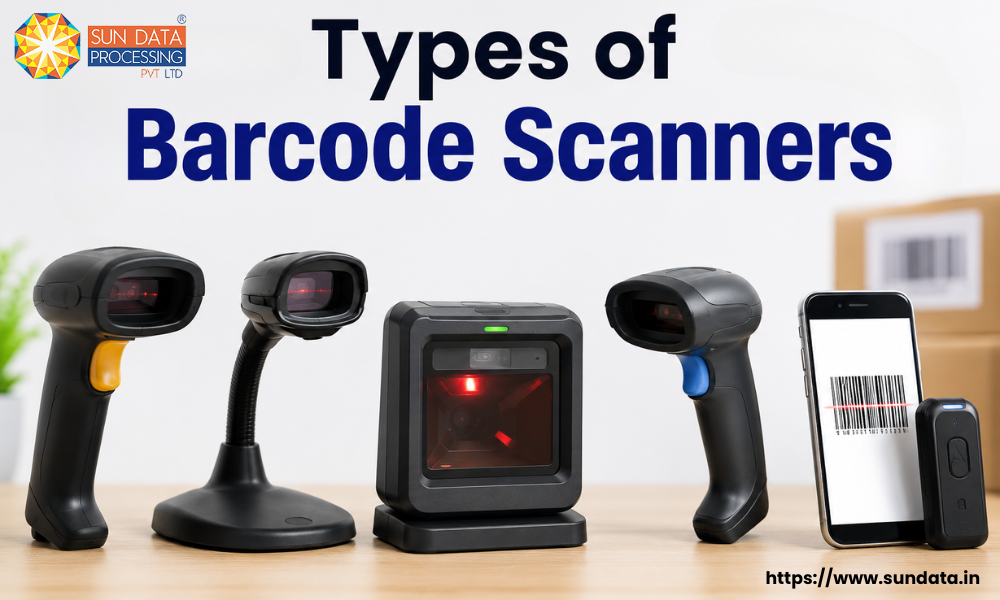
Barcode scanners are devices used to read barcode information and send product data to a computer, POS system, or inventory software. They help businesses record products, prices, stock details, and other information quickly and accurately.
There are several types of barcode scanners, such as handheld, fixed-mount, wireless, pen, and presentation scanners. Each type suits different business needs, based on factors such as scanning speed, barcode type, work environment, and mobility.
The right barcode scanner can reduce manual data entry, speed up daily operations, and improve inventory accuracy. This guide explains the types of barcode scanners and their uses, key features, benefits, industry applications, and how to choose the right scanner for your business.
What Are Barcode Scanners?
A barcode scanner is a device that reads the information stored in a barcode and converts it into digital data. This information is sent to systems such as POS, inventory, or warehouse management software.
Barcode scanners help businesses identify products, update stock records, process billing, and track items without entering product details manually. This makes daily operations faster and reduces data entry errors.
There are different types of barcode scanners, including handheld, wireless, fixed-mount, and presentation scanners. They can also be designed to read 1D barcodes, 2D barcodes, or both. The right scanner depends on the type of barcode, scanning volume, working environment, required scanning distance, and business needs.
Different Types of Barcode Scanners
Businesses use different barcode scanners based on their scanning needs, work environment, and barcode format. Some scanners are designed for fixed workstations, while others allow employees to move around during daily operations.
Handheld Barcode Scanners
Handheld barcode scanners are among the most commonly used scanner types. Employees can hold the device and point it at a barcode to capture product information quickly.
These scanners are suitable for retail counters, warehouses, inventory checks, and product receiving. Wired and wireless models are available to match different working requirements.
Wireless Barcode Scanners
Wireless barcode scanners use technologies such as Bluetooth or Wi-Fi to send scanned information to a connected system. They do not require a cable between the scanner and the computer during use.
These scanners are useful in warehouses, stores, and large work areas where employees need to move between different locations. They provide more flexibility during stock checking and item tracking.
Handheld Bluetooth Scanners
Handheld Bluetooth Scanners are portable scanners that connect wirelessly to computers, tablets, POS systems, or other compatible devices. They allow employees to scan products without being restricted by a cable.
These scanners are useful in retail stores, warehouses, inventory management, and other areas where employees need to move around while scanning products. Their wireless design makes them convenient for stock checking, product receiving, and order processing.
Presentation Barcode Scanners
Presentation scanners are designed for quick scanning at retail counters and checkout areas. The scanner can read a barcode when the product is placed in front of its scanning window.
Employees do not need to pick up and aim the scanner for every item. This makes presentation scanners useful for supermarkets, retail stores, and other high-volume checkout environments.
Pen-Type Barcode Scanners
Pen-type scanners have a slim, pen-like design and read barcodes when the scanning tip is moved across them. They are simple and lightweight compared with many other scanner types.
These scanners can be useful for basic barcode reading tasks where scanning speed and advanced features are not major requirements. Their use is more limited compared with modern image-based scanners.
2D Barcode Scanners
2D barcode scanners use an imaging sensor to read two-dimensional codes such as QR codes and Data Matrix codes. Many models can also read traditional 1D barcodes.
These scanners are suitable for retail, logistics, healthcare, manufacturing, and inventory applications. They are a good choice when a business needs to scan both 1D and 2D barcodes.
How Do Barcode Scanners Work?
A barcode scanner reads the pattern on a barcode and converts it into digital information. The scanner then sends the data to a connected system such as POS, inventory, or warehouse management software.
Barcode Capture
The scanner captures the barcode using a laser, LED light, or camera-based imaging system. It detects the lines, spaces, or patterns printed on the barcode.
The scanning method depends on the type of barcode scanner. Modern image-based scanners can capture barcodes from different angles and can also read 2D codes such as QR codes.
Barcode Data Reading
The scanner identifies the pattern captured from the barcode and reads the information stored in it. A built-in decoder helps convert the barcode pattern into usable data.
The information may include a product number, item code, serial number, or other details. The scanner completes this process within a very short time.
Data Conversion
The captured barcode pattern is converted into digital data that the connected system can understand. The decoder plays an important role in this process.
Once the data is converted, the scanner prepares it for transfer to the computer, POS system, or business software. No manual product code entry is required.
Data Transfer
The scanner sends the decoded information to the connected system through a cable, Bluetooth, Wi-Fi, or another supported connection. The connection type depends on the scanner model. The system receives the scanned data and uses it for the required business task. This can include billing, stock updates, product identification, or item tracking.
System Update
The connected software processes the barcode data and updates the relevant records. For example, a stock system can reduce inventory after a sale or record an item received in a warehouse.
Important Features of Barcode Scanners
Barcode scanners come with different features based on their design and intended use. The right features can help businesses choose a scanner that fits their daily scanning requirements.
Scanning Speed
Scanning speed shows how quickly a scanner can read a barcode and process the information. High-speed scanning is useful for businesses that handle a large number of products every day. Retail stores, warehouses, and distribution centers often need fast scanning to keep work moving.
Barcode Compatibility
Barcode compatibility determines which barcode formats a scanner can read. Some scanners support only 1D barcodes, while others can read both 1D and 2D codes. Businesses should check the barcode formats used on their products before selecting a scanner.
Wired or Wireless Connectivity
Barcode scanners can connect to business systems through USB, Bluetooth, Wi-Fi, or other connection methods. Wired scanners are suitable for fixed workstations, while wireless models provide greater mobility.The choice depends on where the scanner will be used.
Scanning Distance
Scanning distance refers to how far the scanner can read a barcode accurately. Standard scanners work well at short distances, while long-range models are designed for applications where items cannot be reached easily.Warehouse employees may need to scan products stored on shelves or pallets.
Durability
A barcode scanner used in warehouses, factories, or outdoor areas may face drops, dust, moisture, and frequent handling. Durable models are designed to handle these working conditions.Businesses should consider factors such as drop resistance, dust protection, and water resistance when selecting a scanner.
Ease of Use
A barcode scanner should be comfortable to hold and simple to operate. Easy-to-use controls can help employees scan products without spending much time learning the device.Weight, grip, trigger design, display, and feedback signals can all affect user comfort.
Key Benefits of Barcode Scanners
Barcode scanners help businesses handle product and inventory information with less manual work.
Faster Data Entry
A barcode scanner can capture product information within seconds. Employees do not need to type long product codes or item numbers into the system manually.This saves time during billing, stock checks, and warehouse operations.
Better Inventory Accuracy
Barcode scanning reduces errors that can occur when product details are entered manually. Each scan provides the system with the information linked to that particular barcode.Accurate data helps businesses maintain better stock records.
Less Manual Work
Employees can scan an item instead of entering its details into the system. The scanner transfers the information directly to connected business software. This reduces repetitive data entry and allows staff to spend less time on routine tasks.
Improved Product Tracking
Barcode scanners help businesses record the movement of products from one location to another. Each scan can create a record of when and where an item was processed. This is useful for receiving, picking, packing, shipping, and stock transfers.
Easy System Integration
Modern barcode scanners can connect with POS systems, inventory software, warehouse management systems, and other business applications. Different connection options are available based on the scanner model. This allows scanned information to move directly into the required system.
Better Employee Productivity
Quick and simple scanning helps employees complete routine tasks in less time. Staff can process products, check stock, and update records without entering every detail manually. This can improve the overall flow of daily operations.
Industries That Use Barcode Scanners
Barcode scanners are used in many industries to identify products, manage inventory, track items, and record transactions.
Chemical Industry
Chemical industries use barcode scanners to track raw materials, chemical containers, batches, and finished products. Scanning helps maintain accurate records and supports proper identification during storage, production, and dispatch.
Garment Industry
Garment businesses use barcode scanners to manage fabrics, clothing items, sizes, colors, and stock quantities. Scanning makes it easier to track products from production and storage to billing and order dispatch.
Jewellery Industry
Jewellery businesses use barcode scanners to identify and track individual jewellery pieces, product codes, prices, and stock details. Scanning helps staff maintain accurate inventory records and quickly locate specific items.
Retail Industry
Retail stores use barcode scanners for billing, product identification, stock checking, and receiving goods. Handheld and presentation scanners help employees process products quickly and reduce manual data entry.
E-commerce
E-commerce businesses use barcode scanners to manage products and online orders in fulfillment centers. Scanning helps staff locate items, verify orders, update stock, and prepare packages for dispatch.
Future Trends in Barcode Scanning Technology Barcode scanning technology is becoming more connected, faster, and easier to use. New developments are helping businesses handle product data, inventory, and tracking with greater speed and accuracy.
AI-Based Barcode Scanning
AI and image recognition are being added to modern scanning systems to improve barcode reading in different conditions. These systems can help identify damaged, poorly printed, or partially visible barcodes.
Mobile Barcode Scanning
Smartphones and mobile devices are becoming useful tools for barcode scanning. Businesses can use mobile scanning applications for inventory checks, stock counting, order processing, and field operations.
Cloud-Based Integration
Cloud-connected barcode systems can send scanning data directly to online business applications. This allows companies to access updated inventory and product information across different locations.
2D Barcode Adoption
2D barcodes such as QR codes and Data Matrix codes are becoming more common across industries. They can store more information than traditional 1D barcodes and support product tracking, authentication, and other business applications.
Automated Scanning
Automated barcode scanning is gaining importance in warehouses, manufacturing plants, and distribution centers. Fixed scanners and automated systems can capture product information as items move through conveyors and processing areas.
How to Select the Right Barcode Scanner for Your Business
Consider the type of barcode you use, the number of items scanned each day, the working environment, and the distance from which employees need to scan products.
The barcode format is an important factor. A 1D scanner is suitable for traditional barcodes, while a 2D scanner is a better choice if your business uses QR codes or other two-dimensional barcodes.
The work environment should also be considered before making a decision. Retail stores may need compact handheld or presentation scanners, while warehouses and manufacturing units may require rugged scanners that can handle frequent use and difficult conditions.
Connectivity is another important point. Wired scanners work well at fixed locations such as billing counters, while wireless scanners are useful when employees need to move around warehouses, stockrooms, or large work areas.
You should also check whether the scanner is compatible with your existing POS, inventory management, or warehouse management system. For businesses with high scanning volumes, a fast and durable scanner can be a better choice for continuous daily use.
FAQ
1. Can barcode scanners read damaged barcodes?
Some modern scanners can read slightly damaged or poorly printed barcodes. Their performance depends on the scanner technology and barcode condition.
2. Can one scanner read different barcode formats?
Yes, many scanners can read multiple barcode formats. 2D scanners can often read both 1D and 2D barcodes.
3. How long do barcode scanners last?
A barcode scanner can last for several years with proper use and maintenance. Its lifespan also depends on usage and workplace conditions.
4. Can barcode scanners work without the internet?
Yes, most barcode scanners can work without the internet. Internet access is mainly required when the scanner connects to cloud-based systems.
Conclusion
Barcode scanners are a simple and practical way to manage product information and daily business operations. They help reduce manual work, improve data accuracy, and make tasks such as billing, inventory checking, product tracking, and order processing easier.
The types of barcode scanners and their uses vary according to business requirements. A small retail store, warehouse, manufacturing unit, or jewellery business may need different scanning solutions based on its products and working process.
The best scanner is one that fits your barcode type, workload, workplace, and existing system. With the right barcode scanner in place, businesses can handle routine scanning tasks more smoothly and maintain accurate records as their operations grow.
