



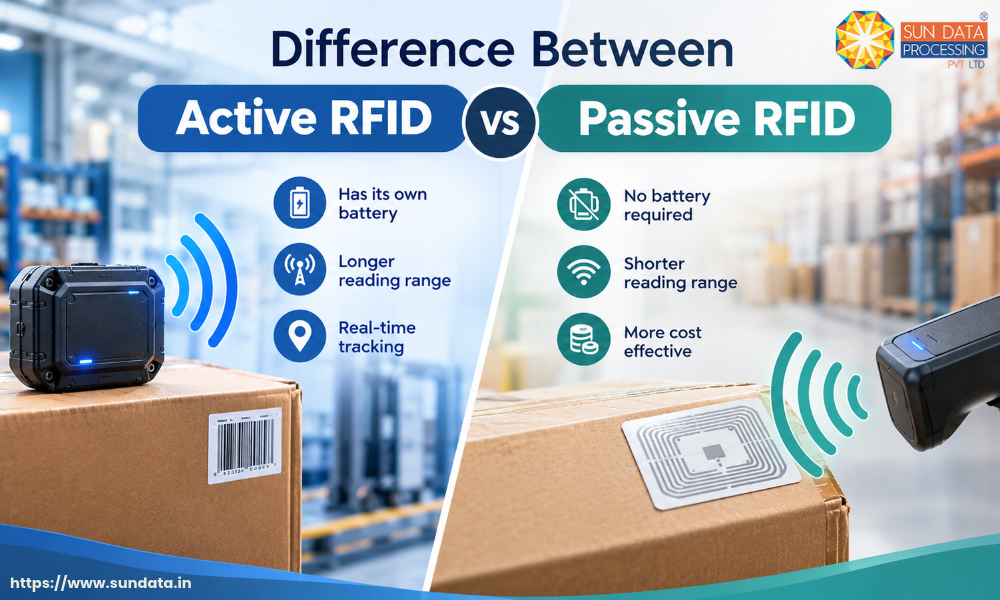
Active RFID and passive RFID are two common types of Radio Frequency Identification (RFID) technology used to track and identify items. Both use radio waves to transfer data, but they differ in how they get power, their reading range, and their cost.
The main difference between active RFID vs passive RFID is that active RFID tags have their own power source, while passive RFID tags get power from the RFID reader's signal. This difference affects how far tags can be read and where each type works best.
Active RFID is often used to track vehicles, equipment, and assets over longer distances. Passive RFID is commonly used for inventory management, product tracking, retail, and supply chain operations.
The right choice depends on your business needs, tracking distance, budget, and the type of items you want to track. This guide explains the difference between active vs passive RFID, their advantages, limitations, applications, and how to select the right technology for your business.
What Is an Active RFID Tag?
An active RFID tag is a type of RFID tag that has its own power source, usually a battery. It uses this power to transmit signals to an RFID reader, which helps businesses identify and track items over longer distances.
Active RFID tags are commonly used to track vehicles, industrial equipment, containers, and valuable assets. They are useful in places where businesses need regular updates about the location or movement of items.
Compared with passive RFID tags, active RFID tags usually have a longer reading range and can support more frequent tracking. They also tend to be larger and more expensive because they contain a battery.
How Active RFID Tags Work
Active RFID tags use a built-in battery to send radio signals to an RFID reader. The reader receives these signals and sends the tag's data to an RFID system, where businesses can view and manage tracking information.
Here is how the process works:
Power supply: The battery provides power to the active RFID tag.
Signal transmission: The tag sends radio signals containing its identification data.
Signal reception: An RFID reader receives the signals when the tag is within its reading range.
Data processing: The system processes the information and displays it in tracking software.
When Should You Choose an Active RFID Tag?
An active RFID tag is a good choice when your business needs to track assets over long distances or monitor their movement regularly. Its built-in battery allows it to transmit signals without depending on power from an RFID reader.
You should consider active RFID tags in the following situations:
Long-distance tracking: When you need to track items across large warehouses, factories, yards, or storage facilities.
Real-time asset monitoring: When you need frequent updates about the location of equipment, vehicles, or containers.
Tracking valuable assets: When your business handles expensive machinery, industrial tools, or other high-value items.
Large-scale operations: When staff need to locate moving assets across a wide area without scanning each item manually.
Advantages of Active RFID Tags
Active RFID tags offer several benefits for businesses that need to track assets over large areas. Their built-in power source allows them to transmit signals over longer distances than most passive RFID tags.
The main advantages of active RFID tags include:
Longer reading range: Active RFID tags can be read from greater distances, depending on the tag and system setup.
Frequent tracking updates: They can transmit data regularly, which helps businesses monitor the movement of assets.
Easy asset location: Staff can locate equipment, vehicles, and containers without checking each item manually.
Suitable for large areas: Active RFID works well in large warehouses, factories, logistics yards, and other wide spaces.
Support for monitoring: Some active RFID tags include sensors that can collect information such as temperature, depending on the tag's features.
Disadvantages of Active RFID Tags
Active RFID tags provide a longer reading range, but they also have some limitations. Businesses should consider these factors before choosing active RFID technology.
Higher cost: Active RFID tags are generally more expensive than passive RFID tags because they contain a battery and more electronic components.
Battery maintenance: The battery has a limited life and needs replacement or recharging, depending on the tag type.
Larger size: The battery and internal components can make active RFID tags bigger than passive tags.
Limited battery life: Tags may stop transmitting when their batteries run out, which can affect tracking operations.
More maintenance: Businesses may need to monitor battery levels and replace batteries to keep the system working properly.
What Is a Passive RFID Tag?
A passive RFID tag is a type of RFID tag that does not have its own battery. It gets the power it needs from the radio waves sent by an RFID reader. Once powered, the tag responds to the reader with its stored identification data.
Passive RFID tags are commonly used for inventory management, retail products, warehouse operations, library books, and supply chain tracking. They are available in different sizes and forms, including labels, stickers, cards, and hard tags.
Compared with active RFID tags, passive RFID tags are generally smaller, less expensive, and require less maintenance because they do not have a battery. Their reading range is usually shorter, and the actual distance depends on the tag type, frequency, reader, and surrounding environment.
Passive RFID is a practical choice for businesses that need to identify and track large numbers of products or items at a lower cost.
How Passive RFID Tags Work
Passive RFID tags use energy from an RFID reader to send their stored data back to the system. Since these tags do not have a battery, they depend on the reader's signal to operate.
Here is how the process works:
Signal transmission: The RFID reader sends radio waves toward the passive RFID tag.
Power collection: The tag's antenna collects energy from the reader's signal.
Data response: The tag uses this energy to respond with its stored identification information.
Data processing: The reader receives the response and sends the information to the connected software for tracking and record management.
When Should You Choose a Passive RFID Tag?
A passive RFID tag is a good choice when your business needs to identify and track a large number of items at an affordable cost. These tags work well when products pass through fixed reading points, such as warehouse entry gates, checkout counters, or inventory stations.
You should consider passive RFID tags in the following situations:
Inventory management: When you need to count stock and update inventory records in warehouses or retail stores.
Product tracking: When you need to identify products, cartons, or packages throughout your supply chain.
High-volume operations: When your business needs to tag thousands of items without spending too much on each tag.
Access control: When you need RFID cards or tags to manage entry to offices, buildings, or restricted areas.
Supply chain operations: When you need to identify goods as they move between storage areas, warehouses, and distribution centres.
Advantages of Passive RFID Tags
Passive RFID tags are widely used because they offer a cost-effective way to identify and track products. Since they do not need a built-in battery, they are easy to maintain and suitable for businesses that handle large volumes of items.
The main advantages of passive RFID tags include:
Lower cost: Passive RFID tags are generally cheaper than active RFID tags, making them suitable for tagging large numbers of products.
Small and lightweight: These tags are available in compact forms, such as labels, stickers, and cards, that can be attached to different items.
No battery required: Passive RFID tags get power from the reader, so there is no need to replace or recharge batteries.
Low maintenance: The absence of a battery reduces routine maintenance requirements.
Efficient inventory tracking: RFID readers can identify multiple tagged items at once, which can help speed up stock counting and inventory checks.
Disadvantages of Passive RFID Tags
Passive RFID tags are affordable and easy to maintain, but they have some limitations. Businesses should understand these factors before selecting passive RFID technology for their tracking needs.
Shorter reading range: Passive RFID tags usually work over shorter distances than active RFID tags. The range depends on the tag's frequency, reader, and environment.
Dependence on the reader: These tags need energy from an RFID reader to respond, so they cannot transmit data independently.
Signal interference: Metal surfaces, liquids, and other environmental factors can affect reading performance, depending on the RFID frequency and setup.
Limited tracking updates: Passive RFID tags do not independently send regular location updates, which makes them less suitable for continuous real-time tracking.
Reading limitations: Tag placement, distance, and surrounding materials can affect whether a reader detects the tag correctly.
Active RFID vs Passive RFID: Key Differences
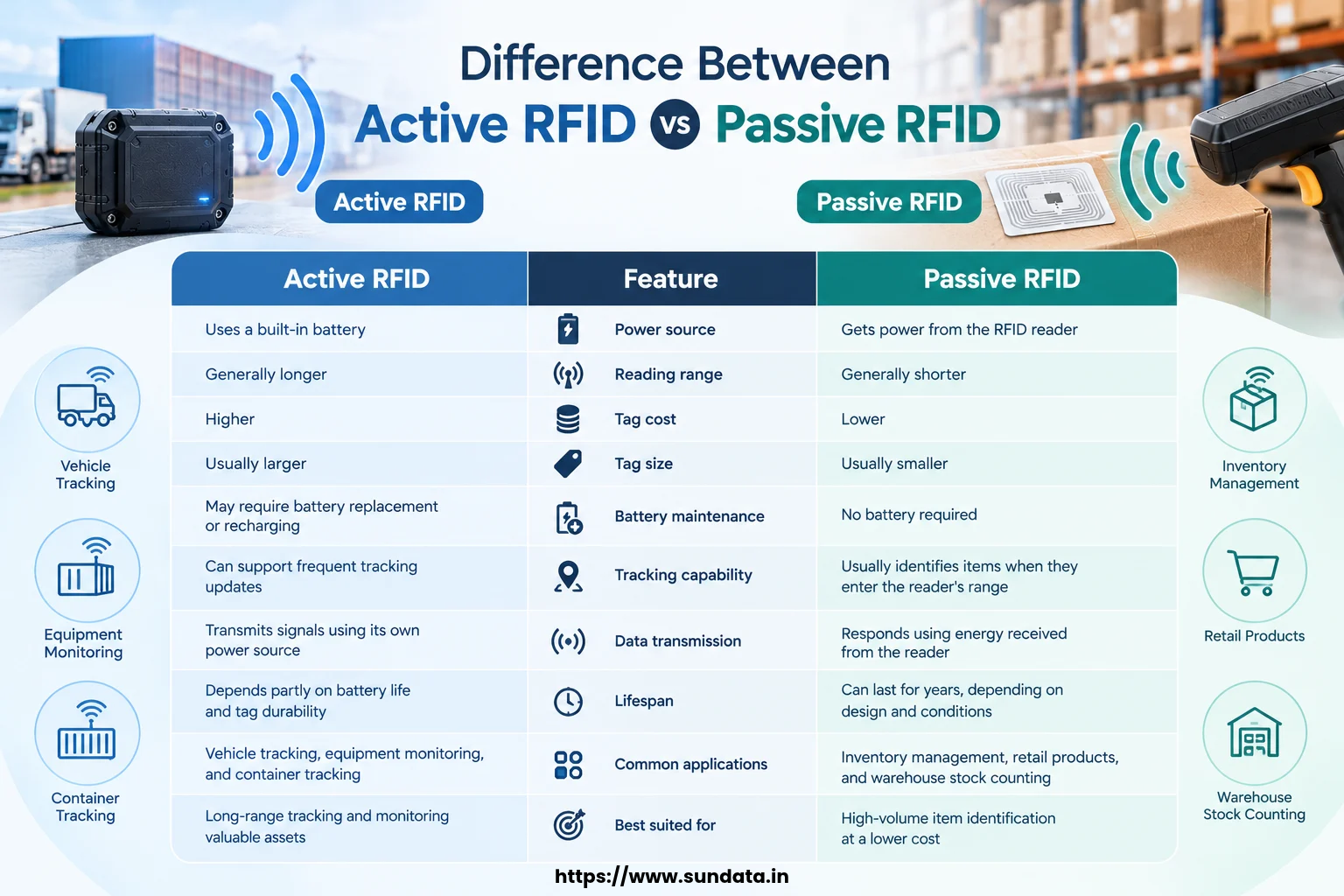
The main difference between active RFID vs passive RFID is how the tags receive power and communicate with an RFID reader. Here are the key differences between these two technologies.
1. Power Source
Active RFID tags have a built-in battery that powers their signal transmission. Passive RFID tags do not have a battery and get the energy they need from the RFID reader's radio waves.
2. Reading Range
Active RFID tags generally work over longer distances than passive RFID tags. Passive RFID tags usually need to be closer to the reader, depending on the tag type and system setup.
3. Tag Cost
Active RFID tags are more expensive because they contain a battery and additional electronic components. Passive RFID tags are more affordable, making them suitable for businesses that need to tag large numbers of items.
4. Tag Size
Active RFID tags are usually larger because they contain a battery and other internal components. Passive RFID tags are often smaller and lighter, making them suitable for product labels, cards, and compact tags.
5. Maintenance Requirements
Active RFID tags may require battery replacement or recharging over time. Passive RFID tags do not need battery maintenance, which helps reduce ongoing maintenance work.
6. Tracking Capability
Active RFID systems can support frequent tracking updates and location monitoring, depending on the system design. Passive RFID systems mainly identify items when they come within the reader's range.
7. Lifespan
The battery life of an active RFID tag can affect how long it operates before maintenance is needed. Passive RFID tags can remain usable for many years because they do not rely on a battery, provided the tag remains physically intact.
8. Common Applications
Active RFID is commonly used for tracking vehicles, industrial equipment, shipping containers, and valuable assets. Passive RFID is widely used for retail products, warehouse inventory, library books, and supply chain identification.
9. Best Use Cases
Active RFID is suitable for businesses that need long-range tracking and regular asset updates. Passive RFID is a better fit for businesses that want cost-effective product identification and inventory management.
The table below explains the key differences between active RFID vs passive RFID.
Common Applications of Active RFID Tags
Active RFID tags are commonly used in industries that need to track assets over long distances or monitor their movement regularly. Their built-in battery allows them to transmit signals without depending on power from an RFID reader.
Some common applications of active RFID tags include:
Vehicle Tracking
Active RFID helps businesses track vehicles across warehouses, industrial sites, parking areas, and logistics yards. It can help staff identify vehicle movement and manage vehicle entry and exit.
Warehouse Asset Tracking
Warehouses use active RFID tags to track forklifts, pallets, containers, and other valuable equipment. This helps staff locate assets quickly and reduces the time spent searching for misplaced items.
Industrial Equipment Monitoring
Manufacturing plants can use active RFID to monitor the movement of machinery, tools, and other important equipment. This helps businesses improve asset visibility and manage equipment usage.
Container and Cargo Tracking
Logistics companies can attach active RFID tags to shipping containers and cargo units. These tags help track assets across large storage yards, ports, and distribution facilities.
Healthcare Asset Tracking
Hospitals can use active RFID systems to track medical equipment, such as wheelchairs, portable monitors, and other movable devices. This helps staff locate equipment when it is needed.
Real-Time Location Systems
Active RFID can support real-time location systems (RTLS) that help businesses monitor the location of tagged assets within a facility. The accuracy and update frequency depend on the system design and the number and placement of readers.
Common Applications of Passive RFID Tags
Passive RFID tags are widely used in businesses that need to identify products, track inventory, and manage large numbers of items at a reasonable cost. Their small size and battery-free design make them suitable for many industries.
Some common applications of passive RFID tags include:
Inventory Management
Warehouses and retail stores use passive RFID tags to identify products and update stock records. RFID readers can detect multiple tagged items at once, helping staff complete inventory checks more quickly.
Retail and Product Tracking
Retailers attach passive RFID tags to clothing, footwear, electronics, and other products. These tags help businesses check stock availability, locate items, and improve inventory accuracy.
Supply Chain Management
Businesses use passive RFID tags to identify cartons, packages, and goods as they move through warehouses and distribution centres. This helps improve product visibility at different stages of the supply chain.
Manufacturing
Manufacturing units use passive RFID tags to identify components, work-in-progress items, and finished products. This helps staff record item movement and manage production processes.
Library Management
Libraries use passive RFID tags on books and other materials. Staff can use RFID readers to identify books, manage borrowing and returns, and complete stock checks more efficiently.
Access Control
Passive RFID cards and key fobs manage access to offices, buildings, and restricted areas. Users can present their cards or tags to compatible readers for identification and access verification.
Asset Identification
Businesses can attach passive RFID tags to tools, files, office equipment, and other assets. When items pass through designated reading points, the system can record their identification and support asset management.
How to Select the Right RFID Technology for Your Business?
The right RFID technology depends on your business needs, tracking distance, and budget. Active RFID suits tracking vehicles, machinery, and valuable assets over longer distances. Passive RFID is a better choice for inventory management, product identification, and tracking large numbers of items at a lower cost.
You should also consider maintenance requirements, the working environment, and compatibility with your existing inventory management software or warehouse management system (WMS). A suitable RFID system can help your business track items efficiently and manage daily operations more smoothly.
In short, choose active RFID for long-range asset tracking and passive RFID for cost-effective inventory management. If your business needs both, you can use a combination of the two technologies.
FAQ
1. Which is better, active RFID or passive RFID?
Active RFID is better for long-range asset tracking, while passive RFID is suitable for affordable inventory management and product identification.
2. Are active RFID tags more expensive than passive RFID tags?
Yes, active RFID tags generally cost more because they contain a battery and additional electronic components
3. Do passive RFID tags need a battery?
No, passive RFID tags get the energy they need from the radio waves sent by an RFID reader.
4. Where are active and passive RFID tags used?
Active RFID tags are used for vehicle tracking, equipment monitoring, and container tracking. Passive RFID tags are commonly used in retail, warehouses, manufacturing, and supply chain management.
5. Can active and passive RFID be used together?
Yes, businesses can use both technologies to track valuable assets over long distances and manage inventory at a lower cost.
Conclusion
Active RFID and passive RFID both help businesses track items and manage operations, but they serve different needs. Active RFID is suitable for long-range asset tracking and frequent monitoring, while passive RFID is a cost-effective option for inventory management and product identification.
The right choice depends on your budget, tracking requirements, and working environment. By understanding the difference between active RFID vs passive RFID, businesses can select the technology that best fits their operations. Some businesses may also benefit from using both technologies together for better asset visibility and inventory control.