Industrial operations depend on speed, accuracy, and smooth movement of goods. A small scanning error can lead to wrong inventory records, shipment delays, or extra manual work.
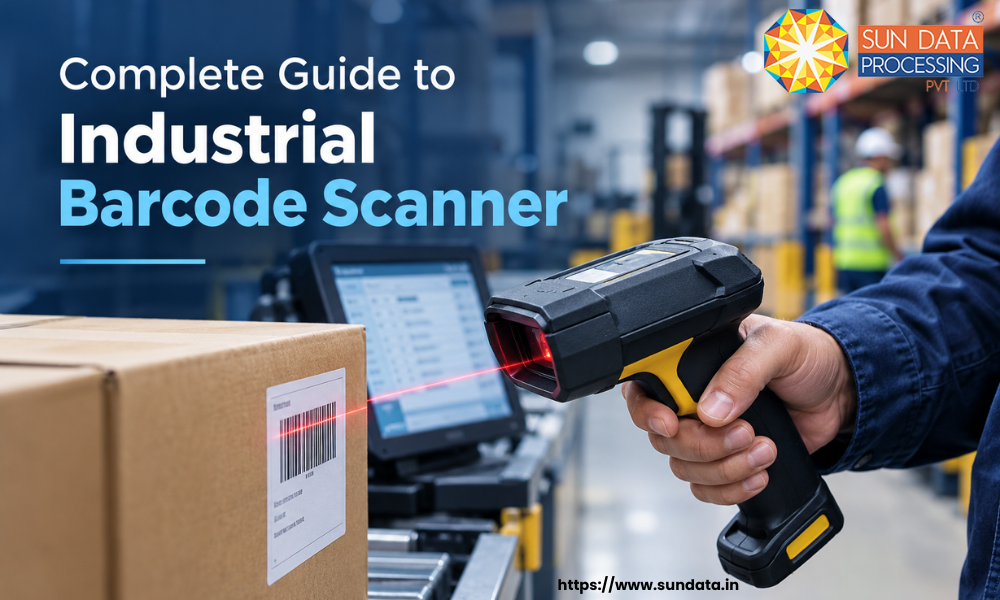
An industrial barcode scanner helps businesses scan barcodes in warehouses, manufacturing units, logistics operations, and other demanding work environments. These scanners are designed to handle regular use, long scanning distances, dust, and rough working conditions.
This guide covers the main types of industrial barcode scanners, their benefits, key selection factors, system integration, and future trends. It will help businesses understand which scanner can best fit their daily operations.
What Is an Industrial Barcode Scanner?
An industrial barcode scanner is a scanning device designed to read barcodes quickly and accurately in demanding work environments. It is commonly used in warehouses, factories, logistics centers, and distribution facilities. Unlike regular scanners, industrial models are built for frequent use and tough conditions.
They can scan barcodes on products, cartons, pallets, and other items while helping reduce manual data entry and scanning errors. Common Types of Industrial Barcode Scanners Industrial barcode scanners are available in different forms to suit different working conditions and scanning needs.
1. Industrial Handheld Barcode Scanner
An industrial handheld barcode scanner is portable and easy to use while moving around a warehouse or factory. It is suitable for receiving, inventory checks, picking, and dispatch.
2. Industrial Rugged Barcode Scanner
An industrial rugged barcode scanner is designed for demanding environments. It can withstand regular drops, dust, moisture, and heavy daily use, depending on the model.
3. Bluetooth Industrial Barcode Scanner
A Bluetooth industrial barcode scanner provides wireless connectivity with computers, tablets, and mobile devices. Workers can scan items from different locations without being restricted by a cable.
4. Mobile Presentation Scanner
A mobile presentation scanner allows users to scan barcodes without manually aiming the scanner at every item. It can be useful at receiving counters, packing stations, and other areas where products are scanned frequently.
5. Fixed-Mount Industrial Barcode Scanner
A fixed-mount scanner is installed at a specific location and scans items as they pass through. These scanners are commonly used on conveyor belts, production lines, and automated systems.
Benefits of Industrial Barcode Scanners for Business Operations
Industrial barcode scanners help businesses improve scanning speed, inventory accuracy, and daily workflow. They are useful for handling large volumes of products in warehouses, factories, and logistics operations.
Faster and More Accurate Data Capture
Barcode scanners capture product information within seconds, reducing the need for manual data entry. This helps workers process items faster while lowering the chances of typing or recording errors.
Better Inventory Control
Accurate scanning helps businesses keep track of stock as products move through receiving, storage, picking, and dispatch. This gives teams more reliable inventory information and helps reduce stock discrepancies.
Higher Worker Productivity
Workers can scan products instead of entering details manually for every item. This saves time during routine tasks and allows employees to handle more work during their shifts.
Reliable Performance in Demanding Conditions
Industrial scanners are designed for workplaces where equipment may face dust, moisture, drops, vibration, or frequent handling. Rugged models are especially suitable for warehouses, factories, and other demanding environments.
Faster Order Processing
Quick barcode scanning helps workers verify products during picking, packing, and dispatch. This can reduce processing delays and help prevent incorrect items from being sent to customers.
Easy Integration with Business Systems
Industrial barcode scanners can connect with WMS, ERP, inventory, and other business systems. Scanned information can then be transferred to the relevant system without repeated manual entry.
How to Choose the Right Barcode Scanner for Your Business
The right barcode scanner depends on your work environment, barcode type, scanning distance, and daily workload. A few practical factors can help you select a scanner that fits your business needs.
Consider the Working Environment
Start by checking where the scanner will be used. Warehouses and factories may have dust, moisture, temperature changes, or frequent drops, so a rugged industrial barcode scanner may be a better option.
Check the Barcode Type
Make sure the scanner can read the types of barcodes used in your business. Some operations use traditional 1D barcodes, while others need 2D codes such as QR codes and Data Matrix codes.
Decide Between Wired and Wireless
A wired scanner can work well at a fixed workstation, while a Bluetooth industrial barcode scanner gives workers more freedom to move around. Your daily workflow should guide this choice.
Check Scanning Distance
Some products need to be scanned from a short distance, while pallets or items stored on high racks may require longer-range scanning. Select a scanner based on the distance workers need to scan from.
Look at Durability
Check the scanner's protection rating, drop resistance, and overall build quality before making a decision. A durable model can be more suitable for businesses where scanners are used continuously throughout the day.
Barcode Scanner Integration with Industrial Systems
Industrial barcode scanners can be connected with different systems to move scanned information directly into business workflows. This reduces manual data entry and keeps operations connected.
Barcode scanners can work with WMS, ERP, inventory, and production systems to record information such as product details, stock movement, and order status. The scanner captures the barcode, while the connected system processes the data for the required task.
Integration can also support mobile devices, cloud platforms, conveyor systems, and other industrial equipment. The exact setup depends on the scanner, software, and workflow used by the business.
A well-integrated barcode scanning system helps teams access accurate information faster and keeps different parts of the operation working from the same data.
Future Trends in Industrial Barcode Scanners
Industrial barcode scanning is changing with new technologies and smarter connected systems. Future scanners are expected to offer better connectivity, faster data capture, and more support for automated operations.
Smarter Scanning Technology
Newer scanners are becoming better at reading damaged, poorly printed, or difficult-to-scan barcodes. Improved scanning technology can help reduce failed scans and keep workflows moving.
Wireless and Connected Scanners
Bluetooth and other wireless technologies are making scanners more flexible for mobile work. Connected devices can also share scanning data with business systems more quickly.
AI-Assisted Barcode Scanning
AI can help scanning systems identify and process barcode information in more complex situations. This can be useful where products, labels, or scanning conditions vary frequently.
Greater Role in Automation
Barcode scanners are increasingly being used with automated storage systems, conveyors, robots, and smart warehouse solutions. This can support faster movement and tracking of goods across industrial operations.
Why Choosing the Right Barcode Scanner Matters
The right barcode scanner can make daily scanning faster, more accurate, and easier for workers. It also helps businesses avoid unnecessary equipment costs and workflow problems.
A scanner that matches the work environment can handle the required scanning volume and conditions more reliably. The right choice also supports smoother inventory tracking, order processing, and product movement.
Businesses should consider factors such as barcode type, scanning range, durability, connectivity, and how the scanner will be used each day. A suitable model can provide better long-term value as operations grow.
Why Choose Sun Data Processing Barcode Scanners?
Sun Data Processing provides barcode scanning solutions for businesses that need reliable and efficient data capture. Its solutions are suitable for different applications across warehouses, manufacturing, retail, logistics, and other industries.
The right barcode scanner can make everyday tasks such as inventory checking, product identification, order processing, and dispatch easier. Sun Data Processing offers scanner options based on different business requirements, work environments, and scanning needs.
With the right barcode scanning solution, businesses can reduce manual data entry and keep product information more accurate. This can support smoother operations and better control over day-to-day processes.
FAQ
1. Can industrial scanners read damaged barcodes?
Many models can read poorly printed or damaged barcodes, depending on the scanner's technology.
2. Are industrial barcode scanners wireless?
Yes, Bluetooth and other wireless models are available for mobile scanning.
3. How long does an industrial barcode scanner last?
Its lifespan depends on build quality, usage, maintenance, and working conditions. Rugged models are generally made for heavy daily use.
4. Does barcode scanning require an internet connection?
Not always. Some scanners can capture data offline and transfer it when a connection becomes available, depending on the setup.
5. Can barcode scanners be used outdoors?
Yes, certain industrial models are designed for outdoor use and can handle conditions such as dust, moisture, and temperature changes.
Conclusion
Industrial barcode scanners help businesses handle scanning, inventory, and product tracking with greater speed and accuracy. The right scanner can also support smoother daily operations across warehouses, factories, and logistics facilities.
Businesses should consider their work environment, barcode requirements, scanning volume, connectivity, and system setup before selecting a model. A suitable scanner can provide reliable performance and support business operations as they grow.
