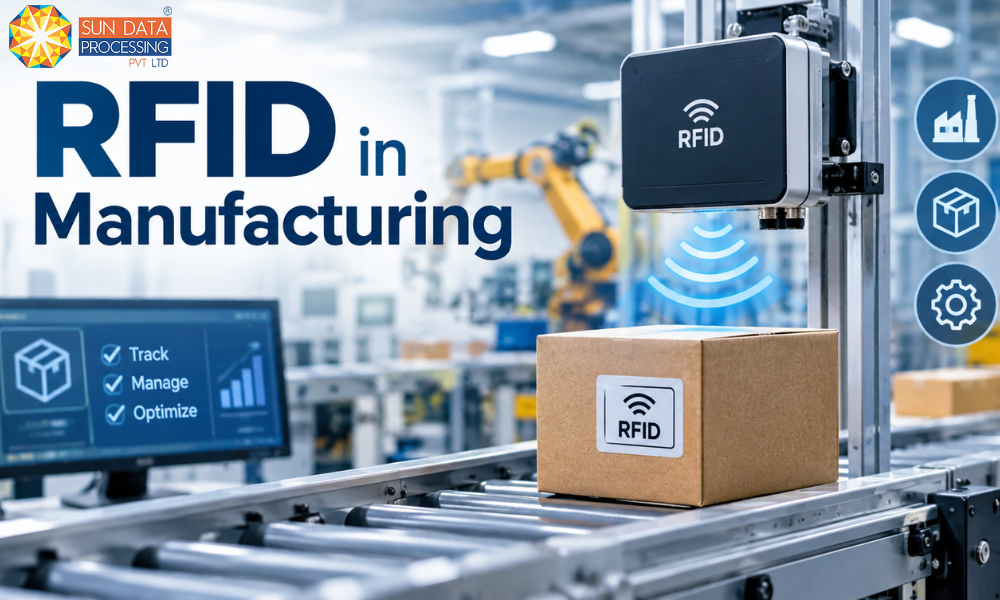
Manufacturing involves moving raw materials, components, work-in-progress items, and finished products across different stages. Tracking these items manually can be time-consuming and may lead to errors.
RFID in manufacturing provides a way to identify and track items using radio waves. RFID tags store product information, while RFID readers collect this information without requiring direct contact or line-of-sight scanning.
This technology can help manufacturers monitor inventory, track materials, improve production visibility, and manage the movement of goods across the facility.
In this guide, we will look at how RFID works, its benefits, different types of RFID systems, and its applications in the RFID manufacturing industry.
The Role of RFID Technology in Manufacturing
RFID technology in manufacturing helps businesses identify and track materials, products, tools, and equipment at different stages of production. It provides real-time information about where an item is and where it has moved.
An RFID tag is attached to an item, container, pallet, or asset. RFID readers capture the tag information and send it to a connected system. This allows production and warehouse teams to access updated information without checking items manually.
RFID can also connect different parts of the manufacturing process. From receiving raw materials to storing finished goods, the system can record item movements and support better inventory control.
For manufacturers, this can reduce manual data entry and make it easier to keep track of materials and products throughout the production cycle.
How RFID Works in Manufacturing
RFID works by using RFID tags, RFID readers, and software to identify and track items. Each tag contains stored information that can be linked to a specific product, material, tool, or asset.
When an RFID tag comes within the reader's range, the reader captures the information through radio waves. The data is then sent to connected software, where it can be recorded and used for tracking.
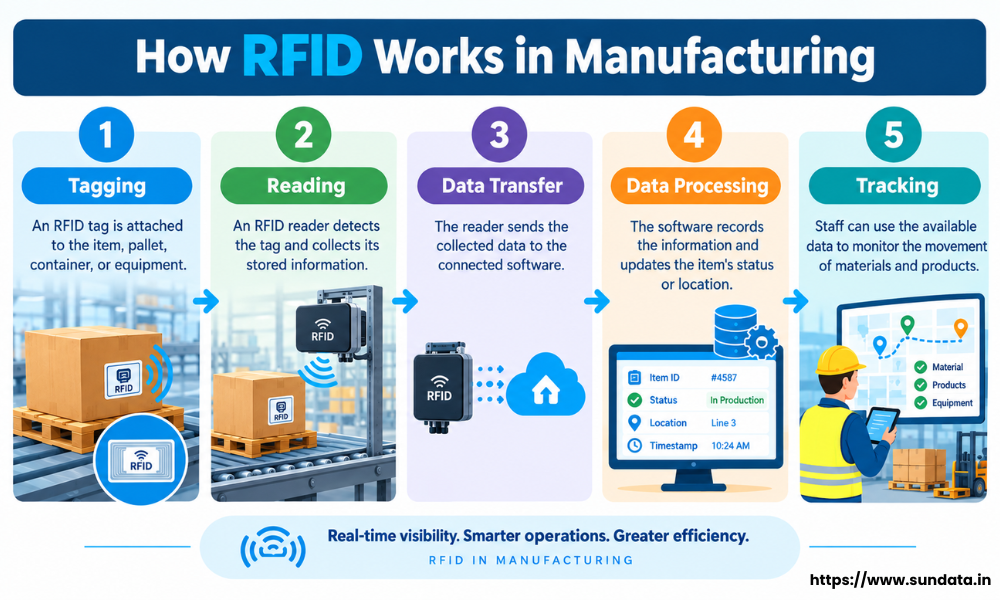
A simple RFID process in manufacturing looks like this:
Tagging: An RFID tag is attached to the item, pallet, container, or equipment.
Reading: An RFID reader detects the tag and collects its stored information.
Data Transfer: The reader sends the collected data to the connected software.
Data Processing: The software records the information and updates the item's status or location.
Tracking: Staff can use the available data to monitor the movement of materials and products.
The Key Benefits of RFID in Manufacturing
RFID can help manufacturers manage materials and production activities with less manual work. It gives teams better visibility of items as they move through different stages.
Better Inventory Tracking
RFID helps track raw materials, components, and finished goods as they enter, move through, and leave the facility. Teams can get updated information without checking every item manually.
Fewer Manual Errors
Manual data entry can lead to mistakes in inventory records. RFID captures item information automatically, which can reduce errors caused by repeated data entry or manual scanning.
Faster Material Handling
RFID readers can identify multiple tagged items within their reading range. This can make receiving, movement, and dispatch processes faster than checking items one by one.
Improved Production Visibility
Manufacturers can track materials and work-in-progress items at different production stages. This gives teams a clearer view of where products are within the manufacturing process.
Better Asset Management
RFID can be used to track tools, equipment, containers, and other reusable assets. When connected with an asset management system, it helps teams monitor asset movement and reduces the time spent looking for misplaced items.
Types of RFID Systems
RFID systems are mainly classified based on the type of tag they use and how the tags communicate with RFID readers. The right system depends on factors such as reading distance, the type of items being tracked, and the manufacturing environment.
1. Passive RFID
Passive RFID tags do not have their own battery. They receive power from the RFID reader when they come within its reading range. These tags are smaller, cost-effective, and commonly used for tracking products, components, cartons, and inventory.
2. Active RFID
Active RFID tags have their own battery, which allows them to send signals over longer distances. They can be used to track larger assets, equipment, vehicles, and items that need continuous monitoring.
3. Semi-Passive RFID
Semi-passive RFID tags contain a battery but usually rely on the RFID reader to communicate. The battery can support functions such as sensors or data storage. These tags can be useful when manufacturers need to monitor specific conditions along with identifying an item.
Implementing RFID Systems in Manufacturing
RFID implementation needs proper planning because every manufacturing facility has different processes, equipment, and tracking needs. A step-by-step approach can make the setup easier to manage.
Identify the Tracking Needs
Start by identifying what needs to be tracked, such as raw materials, work-in-progress items, finished products, tools, or equipment. Define where RFID can provide useful tracking information.
Select the Right RFID Tags and Readers
Select tags based on the material, size, environment, and reading distance required. RFID readers should be placed at points where items need to be identified, such as receiving areas, production lines, storage zones, and dispatch points.
Connect RFID With Existing Software
The RFID system should connect with the software already used by the business, such as an ERP, WMS, or inventory system. This allows collected RFID data to update existing records.
Test the System
Run a small pilot before applying RFID across the entire facility. Test tag readability, reader placement, data accuracy, and system integration under actual working conditions.
Train the Staff
Employees should know how the RFID system works and what they need to do during daily operations. Basic training can help teams use the system correctly and handle common issues.
Monitor and Improve
After implementation, monitor the system regularly. Check reading accuracy, data flow, and system performance, then make changes where needed.
Applications of RFID in the Manufacturing Industry
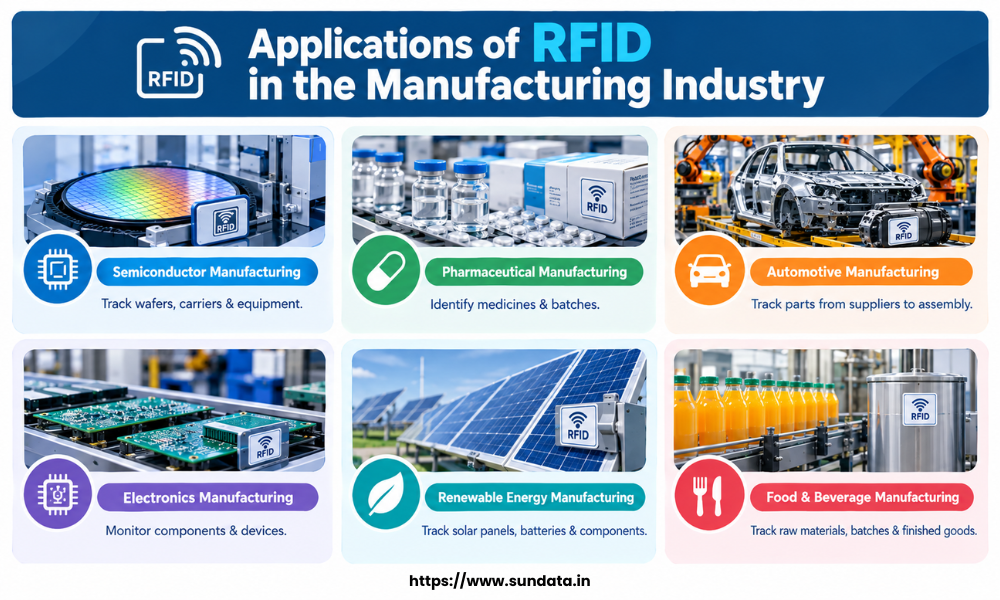
RFID has applications across several manufacturing sectors where products, components, and materials need to be identified and tracked throughout production. Its use can vary based on the processes and tracking requirements of each industry.
Semiconductor Manufacturing
Semiconductor manufacturers can use RFID to identify wafers, carriers, and production equipment. RFID helps track these items as they move between different processing and cleanroom areas.
Pharmaceutical Manufacturing
RFID can support the identification of medicines, packaging materials, and production batches. It can also help maintain product records and improve traceability during manufacturing and packaging.
Automotive Manufacturing
Automotive manufacturers can use RFID to track parts and components from suppliers through different assembly stages. This helps teams maintain visibility of parts and coordinate material movement on the production floor.
Electronics Manufacturing
RFID can be used to track electronic components, circuit boards, and finished devices during production. It helps connect items with their respective production stages and supports better traceability.
Renewable Energy Manufacturing
Manufacturers of solar panels, batteries, and other renewable energy products can use RFID to track components throughout production. The technology can also help maintain records of materials and finished products.
Food and Beverage Manufacturing
RFID can help track raw materials, containers, batches, and finished products across production and storage areas. This supports batch identification and makes product movement easier to monitor.
The Future Trends of RFID in Manufacturing
RFID is becoming more connected with technologies such as IoT, sensors, and cloud platforms. This can help manufacturers collect and share information about materials, products, equipment, and production activities across different areas of a facility.
AI and data analytics can also work with RFID-generated data to identify patterns and support production planning. Manufacturers can use this information to monitor material movement, identify process delays, and make better decisions based on real-time operational data.
As smart factories and automation continue to grow, RFID can become part of connected manufacturing systems. Its integration with automated equipment, ERP, WMS, and other business systems can help create smoother information flow from production to inventory and dispatch.
FAQ
1. Is RFID suitable for small manufacturing businesses?
Yes. Small manufacturers can start with RFID for specific processes such as inventory, tool tracking, or material movement and expand it as needed.
2. Can RFID tags be reused in manufacturing?
Some RFID tags are reusable, especially those used for returnable containers, pallets, and equipment. Reuse depends on the tag type and application.
3. Does RFID work around metal products?
Yes, but metal can affect RFID performance. Special RFID tags and proper reader placement can help improve reading accuracy.
4. How far can an RFID tag be read?
The reading range depends on the RFID frequency, tag type, reader, antenna, and surrounding environment. Different systems support different ranges.
5. Can RFID replace barcodes in manufacturing?
RFID can replace barcodes for some applications, but both technologies can also be used together based on the tracking requirements.
Conclusion
RFID in manufacturing provides a practical way to identify and track materials, products, tools, and assets throughout different operations. It can reduce manual work, improve tracking accuracy, and give teams better visibility into production and inventory.
From production lines and inventory management to asset tracking and product traceability, RFID has applications across many manufacturing processes. Its integration with IoT, AI, automation, and cloud-based systems can also support more connected manufacturing operations.
With the right tags, readers, software, and implementation plan, RFID can become an important part of a modern manufacturing system.
