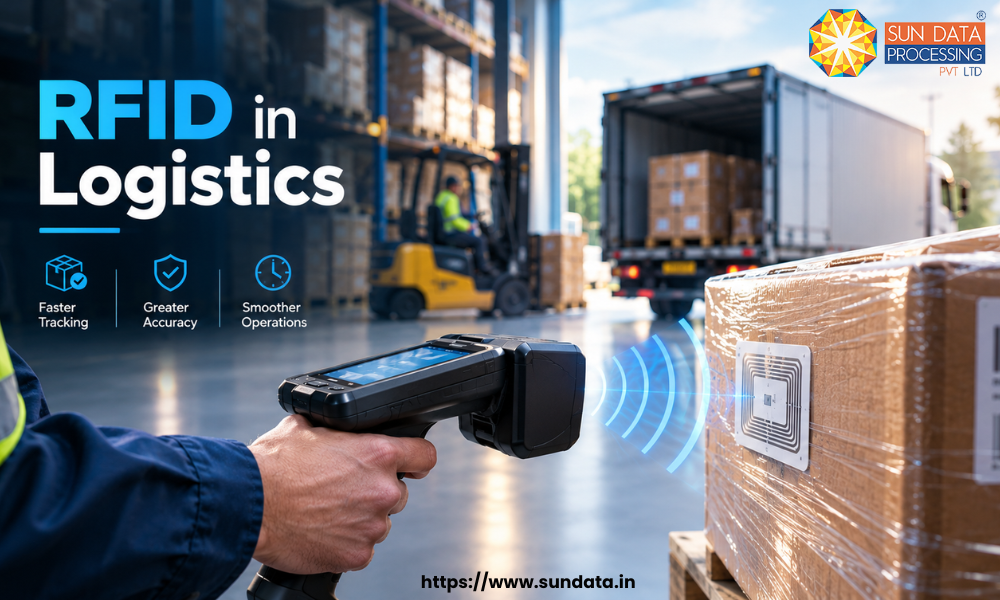
RFID is changing the way businesses track goods, stock, and shipments. It helps logistics teams identify items quickly without checking each product manually.
In a busy warehouse or supply chain, even a small delay can affect deliveries and inventory records. RFID in logistics gives businesses a faster way to track products as they move from storage to dispatch and delivery.
This technology uses RFID tags and readers to collect product information through radio waves. It can reduce manual data entry and give teams better visibility of where goods are in the logistics process.
This guide explains how RFID is used in logistics, its common applications, key benefits, and how it compares with traditional barcodes.
What Is RFID in Logistics?
RFID, or Radio Frequency Identification, is a technology used to identify and track goods using radio waves. An RFID system usually includes a tag, reader, and software that collects and manages the tag data.
An RFID tag is attached to a product, box, pallet, or other item. The tag stores information that can be read by an RFID reader when the item comes within its reading range.
Unlike a barcode, an RFID tag does not always need to be directly visible to the reader. Multiple tagged items can also be read at the same time, which makes RFID technology in logistics useful for warehouses, shipping, receiving, and inventory tracking.
In RFID in logistics and supply chain operations, the collected data can be connected with inventory or warehouse software. This helps teams keep track of goods as they move through different stages of the supply chain.
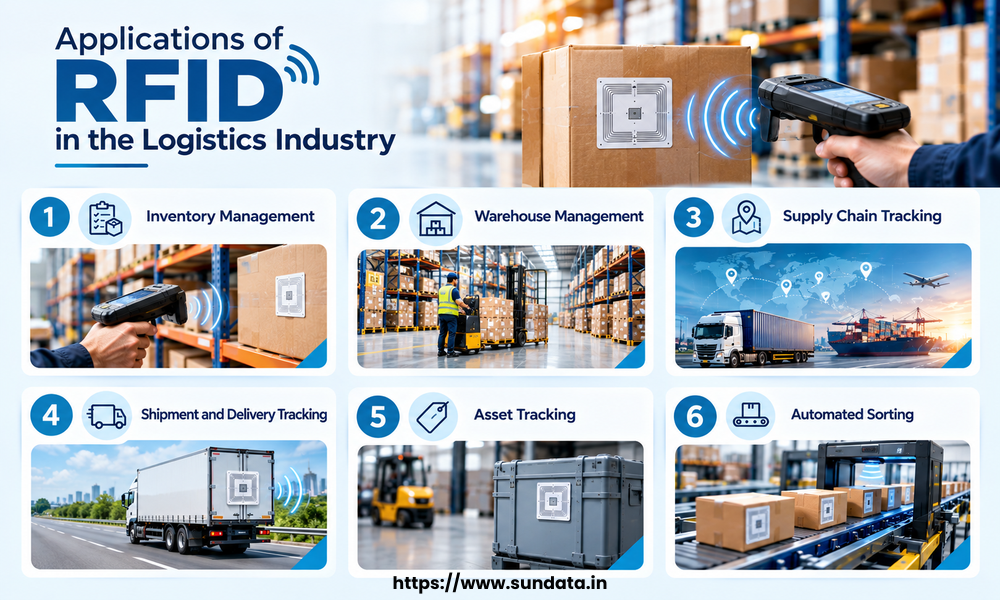
Applications of RFID in the Logistics Industry
RFID is used in many parts of logistics to identify, track, and manage goods and assets. It can be applied from the time products enter a warehouse until they reach the final destination.
1. Inventory Management
RFID helps businesses keep track of products stored in warehouses. Tags attached to products, cartons, or pallets can be read without scanning each item separately. When connected with an inventory management system, RFID can automatically update stock information and make it easier for teams to maintain accurate inventory records. This also makes stock counting faster and reduces the need for repeated manual data entry.
2. Warehouse Management
RFID can be used to monitor the movement of goods inside a warehouse. When connected with a warehouse management system, it can help identify where products are stored and record their movement between different areas. This is useful for warehouses that handle large volumes of products every day, as teams can keep better track of stock and warehouse activities.
3. Supply Chain Tracking
RFID allows companies to track goods as they move through different stages of the supply chain. Information can be recorded when products move between suppliers, warehouses, distribution centers, and retailers. This gives businesses better visibility of product movement across the supply chain.
4. Shipment and Delivery Tracking
RFID tags can be attached to shipments to help identify and track them during transportation. Logistics teams can use the collected information to check whether goods have reached the required location. This can also help reduce problems related to misplaced or incorrectly handled shipments.
5. Asset Tracking
RFID is also used to track logistics assets such as pallets, containers, crates, and reusable packaging. Companies can see where these assets are being used and when they are returned. This helps reduce asset loss and unnecessary replacement costs.
6. Automated Sorting
RFID can support automated sorting in warehouses and distribution centers. Tagged packages can be identified as they pass through RFID readers and directed to the correct area. This is especially useful where large numbers of shipments need to be processed quickly.
How RFID Is Used in Logistics Management
RFID is used in logistics management to track goods as they move through different stages. An RFID tag is attached to a product, carton, pallet, or container. RFID readers capture the tag information when the item passes through a reading point, and the data is sent to the connected software.
The collected information can be used during receiving, storage, order picking, packing, and dispatch. For example, when goods arrive at a warehouse, RFID can record their entry. Later, the same system can help track where the goods are stored and confirm the items before they are sent to the customer.
RFID data can also be connected with warehouse management and inventory systems. This gives logistics teams a more complete view of goods moving through the supply chain and reduces the need for repeated manual data entry.
Benefits of RFID in Logistics Industry
RFID can help logistics companies manage goods with less manual work and better tracking. Its benefits can be seen in warehouse operations, inventory control, and supply chain activities.
Faster Data Collection
RFID readers can identify multiple tagged items at the same time. Workers do not need to scan every product individually, which can save time during receiving, stock counting, and dispatch.
Better Inventory Accuracy
RFID provides automatic records when tagged items move through a reading point. This can help reduce manual entry mistakes and keep inventory information more accurate.
Improved Product Visibility
Businesses can track the movement of goods across different stages of logistics. This helps teams get clearer information about where products are and when they were moved. Reduced Manual Work RFID automates many identification and tracking tasks that are normally handled by workers. This allows staff to spend less time on repetitive ### scanning and data entry. Fewer Shipping and Picking Errors RFID can help verify products during order picking, packing, and dispatch. Identifying tagged items before shipment can reduce the chances of sending the wrong products.
Better Supply Chain Control
RFID data can provide useful information across warehouses, distribution centers, and transportation points. Companies can use this information to monitor operations and respond to issues more quickly.
The Future of RFID Technology in Logistics
RFID technology in logistics is expected to become more connected with warehouse software, inventory systems, and other digital tools. As logistics operations handle more products and shipments, businesses need faster ways to collect and share tracking data.
Newer RFID systems can work with technologies such as IoT, cloud platforms, and automation. This can help businesses collect real-time information about goods, pallets, and other assets across different locations.
RFID can also support smarter logistics decisions. Data collected from tagged items can help companies monitor stock movement, improve warehouse processes, and respond to supply chain issues faster. As these systems become easier to integrate, RFID is likely to remain an important part of modern logistics operations.
Barcode vs RFID: Key Differences for Logistics
Barcodes and RFID are both used to identify and track products, but they work differently. Barcode vs RFID mainly differs in how product information is captured. Barcodes need to be scanned, while RFID uses radio waves to read tags.
FAQ
1. What types of RFID tags are used in logistics?
Logistics operations commonly use passive, active, and semi-passive RFID tags, depending on the tracking range and application.
2. Can RFID work in large warehouses?
Yes. RFID can be used in large warehouses to track products, pallets, containers, and assets across different storage and movement areas.
3. What factors affect RFID performance in logistics?
Tag type, reader range, tag placement, materials around the tag, and the warehouse environment can affect RFID reading performance.
4. Is RFID suitable for cold-chain logistics?
RFID can be used in cold-chain operations to identify and track temperature-sensitive shipments when suitable RFID tags and monitoring systems are used.
5. What are the main challenges of using RFID in logistics?
Initial setup costs, system integration, tag placement, reader installation, and interference from certain materials can be challenges when implementing RFID.
Conclusion
RFID has become a useful technology for tracking goods, managing inventory, and improving visibility across logistics operations. It can reduce manual work and help businesses collect product information faster.
From warehouses and shipments to pallets and supply chains, RFID in logistics can support many day-to-day activities. Its ability to read multiple tags and work without direct line of sight also makes it different from traditional barcode systems.
As logistics becomes more connected and automated, RFID can work with warehouse software, IoT, and other digital systems. Businesses can use it to build more organized and connected logistics operations.
